Vakil Bazaar
Repeating arches, brick vaulting, light falling through ceiling oculi in measured intervals. The rhythm of the arcade shows up in how his patterns repeat and resolve.
About
Two continents, one vocabulary. A designer who learned his craft where it was invented.
Noorarash Charlie was born in America to Iranian parents and spent his early childhood in Los Angeles, inside the largest Iranian community outside Iran itself — a place where Persian was spoken at home, and where the homeland existed mostly as story, music and the smell of a particular kind of cooking.
In 1995 his family made a decision that most diaspora families never make: they went back. Not to Tehran, but to Shiraz — the city of Hafez and Saadi, of walled gardens and orange blossom, of a bazaar whose vaulted ceilings have been throwing the same shadows since the eighteenth century.
He was young enough to absorb it completely. The language stopped being something his parents spoke and became something he thought in. The ornament stopped being decoration and became grammar. He spent hours in the Vakil Bazaar, which is where most of this story really begins — not because he was studying design, but because that is where the craftsmen were.
“I did not choose Persian ornament. I grew up inside it, and later realised I had been given a language.”
He completed a degree in international law. It was, by every conventional measure, the sensible path — and it gave him something the purely artistic route would not have: a working understanding of how ideas move across borders, and how the things a culture makes get valued, protected, or quietly appropriated.
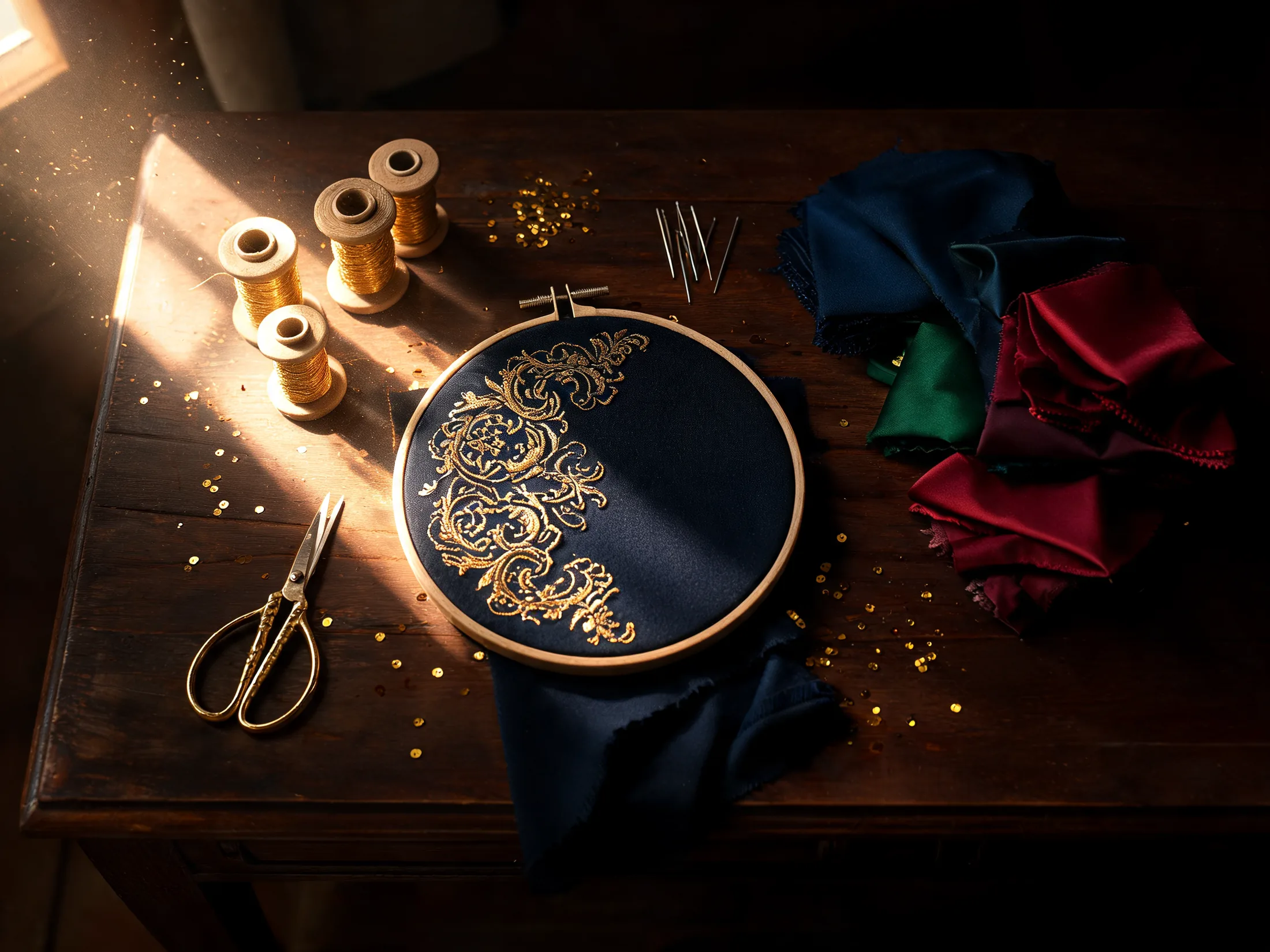
Then he moved to the United Arab Emirates and started making things. What began as a personal obsession with Sermeh embroidery — the gold-thread technique practised in Iran for roughly five hundred years — became a discipline, then a body of work, then a label.
The work now travels further than he does. Pieces have appeared at Cannes, Dubai Fashion Week and in Milan. Each one is still made the slow way, by hand, at a frame, in a process that has refused for five centuries to get any faster.
What Shapes the Work
Not references pulled from a mood board. Places he actually stood in.
Repeating arches, brick vaulting, light falling through ceiling oculi in measured intervals. The rhythm of the arcade shows up in how his patterns repeat and resolve.
The chahar bagh — four quarters divided by water. Symmetry as a spiritual proposition rather than a design choice. Almost every piece is built on an axis.
Read in Shiraz, at the tomb, the way people actually read him there — for guidance, at random. The compression of a ghazal is the same instinct as a small ornament carrying a large idea.
Jewel colour, flattened perspective, and an insistence that detail is not decoration but content. Persian miniature refuses the idea that small means minor.
The interlocking geometry of Isfahan and Shiraz — strapwork that solves itself mathematically. Pattern as proof.
Californian restraint against Persian abundance. The tension is not a problem to resolve; it is the actual signature of the work.