Home About Journey Craft Collection Ventures Contact

The Craft

Sermeh Douzi

Literally: the sewing of gold. A technique that has resisted mechanisation for five hundred years, because the thing that makes it beautiful is precisely the thing a machine cannot do.

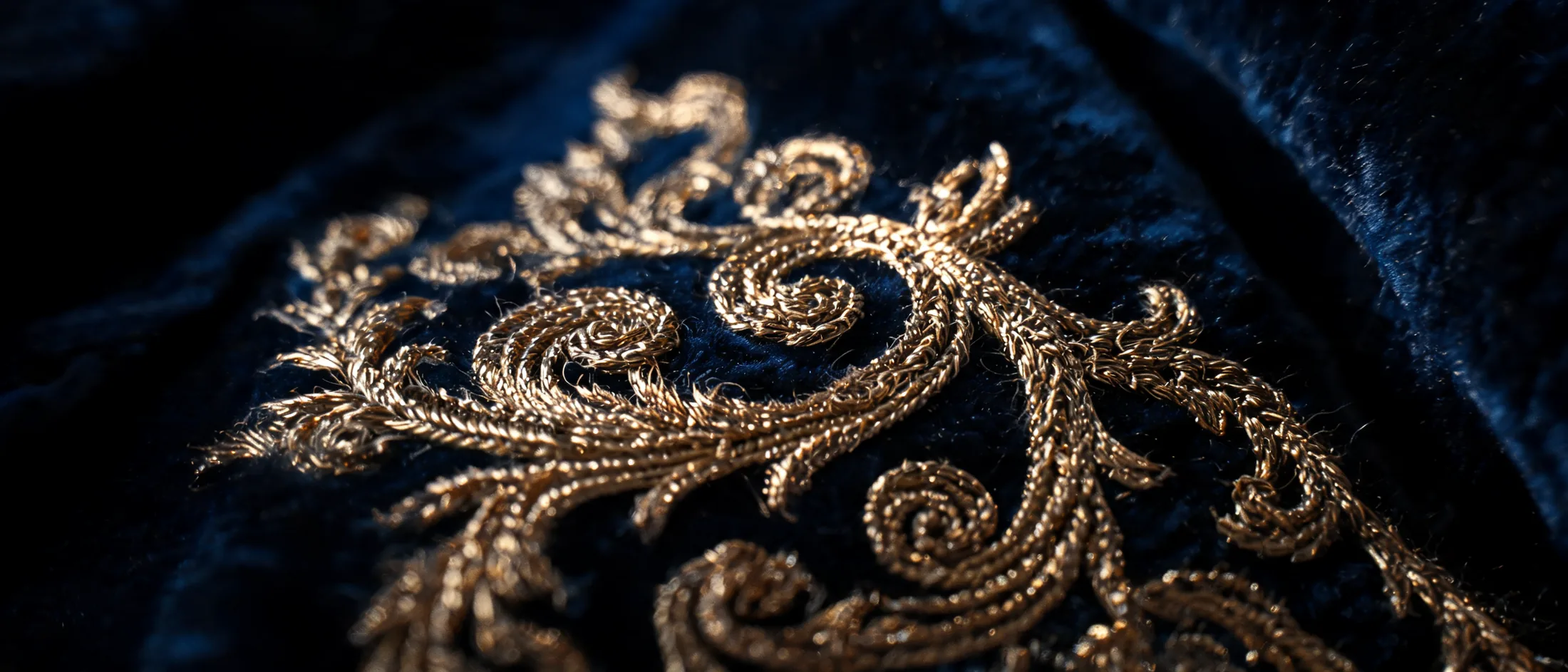
Sermeh is a metal-thread embroidery from Iran, practised at least since the Safavid period. Fine gold or silver-gilt wire is wound into a hollow spring, cut into short beads, and stitched individually onto silk, velvet or wool. The beads are not sewn through — they are threaded like seed pearls and anchored down, which is why a Sermeh surface catches light the way it does.

Historically it covered ceremonial dress, prayer mats, saddle cloths and the interiors of tents belonging to people who could afford tents worth decorating. It survived the twentieth century mostly in Isfahan and Shiraz, in workshops passing the technique down by demonstration rather than instruction.

Method

Six Stages

From an empty frame to a finished piece.

01

Drawing the Arabesque

The pattern is drawn full-size by hand. Persian ornament is not freehand decoration — it is constructed, with an axis and a repeat that must resolve. A design that does not close correctly will read as wrong long before anyone can explain why.
02

Pricking and Pouncing

The drawing is perforated along every line, laid over the cloth, and dusted with fine chalk so the pattern transfers as a dotted ghost. It is the same method used by the Isfahan ateliers, and it is still the most accurate way to move a design onto velvet without marking it permanently.

03

Mounting the Frame

The cloth is stretched drum-tight. Tension is the whole game: too loose and the metal drags the ground into pucker; too tight and the fabric will relax afterwards and the goldwork will ripple. Most failures are decided here, before a single stitch.

04

Coiling and Cutting

Gold wire is wound into a continuous spring, then cut into beads a few millimetres long. Cut lengths must suit the curve they will sit on — shorter through tight scrollwork, longer on open runs — or the line will look faceted instead of fluid.

05

Stitching

Each bead is threaded and couched down individually, following the drawn line. A bow tie face can carry several thousand. This is where the forty hours go, and there is no version of this step that can be hurried without it being visible.

06

Construction and Finish

The embroidered panel comes off the frame, is blocked, cut, and built into the final object — interlined, folded, hand-rolled at the edges, finished with a hardware fitting. Then it is checked in daylight, because gold lies under artificial light.

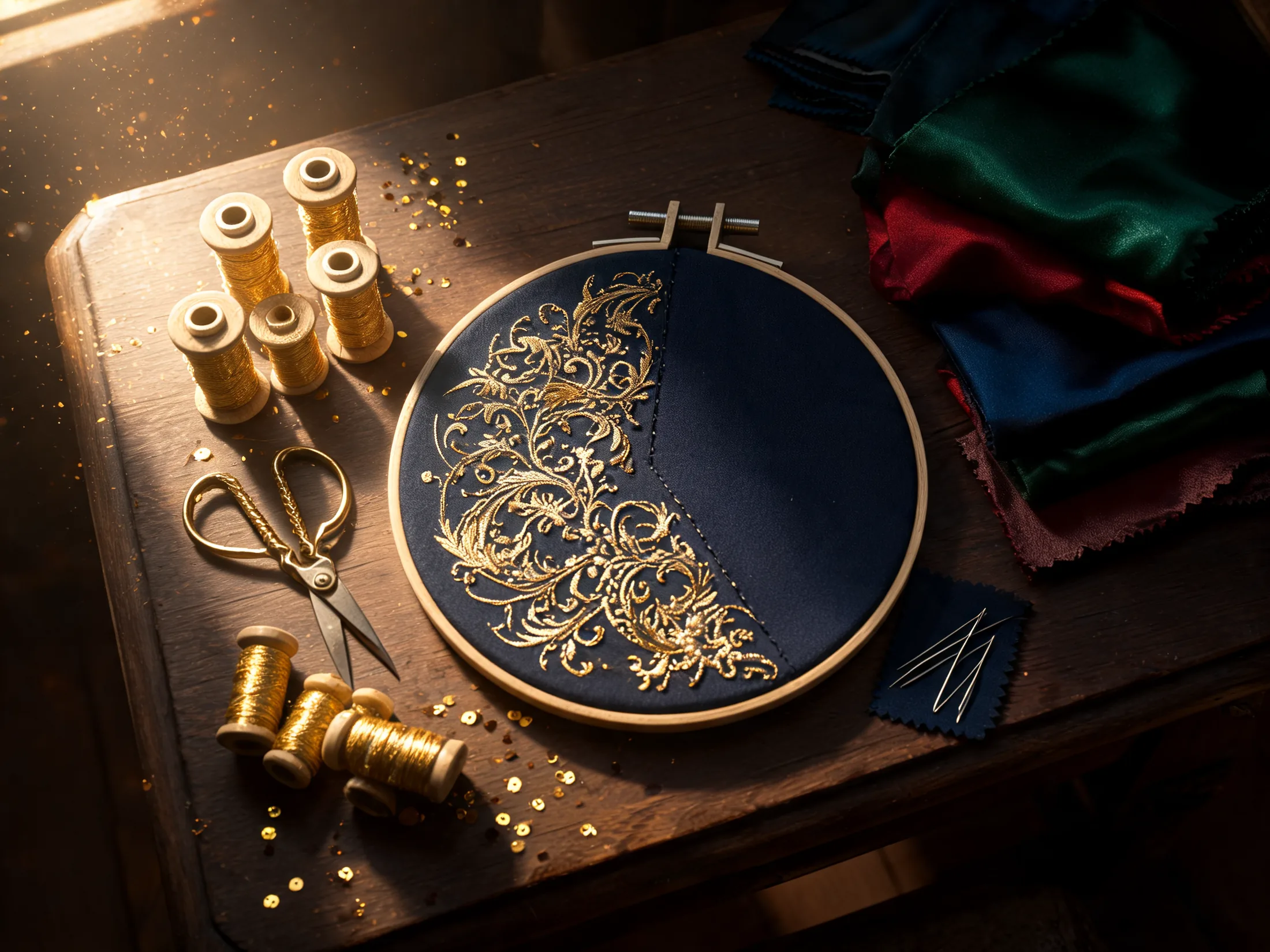
Gold thread, needles and silk swatches on an atelier worktable

Materials

What Goes Into It

  • Metal thread — gold and silver-gilt bullion, in several gauges and finishes; smooth for clean line, textured where the surface needs to break light.
  • Ground cloth — silk velvet, duchesse satin and fine wool. Velvet gives the deepest contrast; satin gives the sharpest reflection.
  • Silk floss — for couching, colour-matched so the anchoring stitch disappears entirely.
  • Sequins and stones — used sparingly, and only where the historical vocabulary actually supports them.
  • Interlining — the unglamorous part that decides whether a piece still holds its shape in five years.

Why It Costs What It Costs

The Arithmetic

0hours at the frame
0beads, roughly, per face
0pair of hands, start to finish
0machine steps

Made to order. Nothing is held in stock, because nothing is made twice.